Speaking Task 4 · Free · 2026 CELPIP format

CELPIP Speaking Task 4: Making Predictions

Five untimed CELPIP Speaking Task 4 questions, each with its own picture and a spoken model answer. Every scene is frozen a second before something lands, and your job is to say what happens next. This is the task candidates lose most often, and the reason is always the same one.

30s prep · 60s speak No timer in this course Nothing recorded is uploaded
How this task works

What CELPIP Speaking Task 4 actually asks you to do

On the real test, Task 4 gives you back the illustration you have just spent 60 seconds describing. Same picture, no changes, and one new instruction: what do you think will most probably happen next. Thirty seconds to prepare, 60 seconds to record.

The five questions below come with pictures of their own. On the exam, one illustration serves Task 3 and Task 4 between them. In this course the two tasks have separate scenes, deliberately, so that you get ten frames of practice rather than five: here it is a self-serve car wash, a ferry terminal, an off-leash dog park, a bank branch and a neighbourhood playground. Each one is built the way a CELPIP scene is built, with several people caught mid action and at least one thing nobody in the frame has noticed yet.

Now the failure, and it deserves to be stated bluntly, because it accounts for more lost marks than every vocabulary gap on this task combined. Candidates describe the picture again. They open with "in this picture I can see a car wash with several bays and a queue of cars", spend 40 of their 60 seconds on the same material the rater heard a minute ago, and squeeze one prediction into the final ten. That answer scores close to nothing on this task, not because it is bad English, but because it answers the previous question. The rater already has your description. The marks are exclusively in the sentences that leave the frame.

Here is the test you can run on your own recording: how many verbs are in the future or the conditional? In a strong Task 4 answer, almost all of them. Is going to, will most likely, would probably, gets soaked the second she straightens up, I doubt that bag stays on the bumper. If you are hearing is and are, you are describing, and describing has already been marked.


The single biggest lever

The certainty ladder

Four predictions all stated with will is four predictions with no ranking. Grading them by how sure you are costs nothing and shows range, precision and judgement at once.

Near certain
"That wand is coming out of his hands, and the woman polishing her headlight in the next bay is getting soaked. That is the one thing I would bet on." Reserve this for the one arc the frame has already decided. Saying so out loud is itself a judgement the rater can hear.
Likely
"The manager will most likely open that third window and halve the queue, and it will work, it just will not happen before the courier reaches the door." Probable, with the small complication that makes it a reading rather than a guess.
Branching
"Either the attendant sees them coming and holds the barrier, or it shuts in the father's face and they wait an hour. Either way, that boy is boarding without his chips, because the seagull has them the moment he is pulled through the gate." Two futures and then a verdict that closes them both. This one sentence does more for your band than any adjective.
Conditional
"If she lets go of that lead, and she is not holding it much longer, the brown dog goes straight through the middle of the ball game and three other dogs change direction at once." A real if clause reaching a consequence nothing in the frame shows. This is complex structure carrying actual content.
Hopeful
"The scooter, hopefully, swerves." Four words on the mildest risk. It acknowledges something without inventing a catastrophe, and it changes the rhythm at the close.

There is a failure mode at each end of that ladder. Live entirely at the top and every outcome is a flat certainty, which sounds confident and reads as a speaker who cannot distinguish a wobbling scooter from a toddler walking into the path of a swing. Live entirely at the bottom and you hedge so heavily, maybe, perhaps, it could be, that no prediction is ever actually made. That second one is worse: Task Fulfillment scores relevance and completeness, and an answer that refuses to commit has not done the task at all.

The other move worth stealing is the chain. Do not leave your predictions as a row of unrelated sentences. Link two: the boy pulls the wand, so the jet swings wide of the hatchback, so the woman polishing her headlight in the next bay straightens up into a face full of cold water. A rater hearing a causal chain hears somebody who read the frame rather than scanned it, and it costs you no extra time at all.

Official format

CELPIP Speaking Task 4 format at a glance

The 2026 CELPIP speaking format for the prediction task specifically.

Official name
Speaking Task 4: Making Predictions
Position
Fourth of the 8 speaking tasks, immediately after the scene description
Preparation
30 seconds, not skippable
Recording
60 seconds
What you see
On the exam, the same illustration as the previous task, unchanged. In this course, five illustrations belonging to Task 4 alone, so the two picture tasks give you ten scenes between them.
The instruction
What will most probably happen next. Note the word probably: this is a reading of the evidence, not a story.
Roughly
130 to 150 words at a natural pace, which is 3 or 4 predictions from different parts of the frame
Scored on
Content and Coherence, Vocabulary, Listenability, Task Fulfillment
Rater view

What raters actually reward in CELPIP Speaking Task 4

Once you have stopped re-describing, five things separate a competent prediction from a high one.

Triage out loud
"The toddler is the urgent one." "The courier is the accident here." Naming which arc you are dealing with and why it is first gives the answer a spine from the opening words, and it tells the rater you ranked the frame rather than reading it left to right.
Evidence, not invention
"He is reversing through a glass door with a parcel he cannot see around, and the queue starts about a metre behind him, so ..." The so is the whole move: a fact from the frame, then the future it implies. A prediction with no visible cause behind it is a guess, and it sounds like one.
Reason from constraints
"You cannot hold a dog that size when it is already up on its back legs and the only thing between it and a tennis ball is your grip." That is not a guess about the woman, it is arithmetic about the world, and it is exactly the abstract reasoning the top bands want.
Predict people, not just objects
Most candidates predict what falls over. The stronger answer predicts a motive and a timing: the boy at the candy bowl tries once more and then gives up, because he can tell his mother means it. Objects are the easy half of the frame.
One prediction that is not a disaster
"The queue will probably sort itself out. The manager is already on his feet and pointing at an empty window." A frame where everything ends badly is a caricature, and the rater can tell you reached for comedy rather than probability. One calm outcome proves you were reading.

It is worth understanding why these scenes feel so full of imminent mishaps. A picture that works for prediction has to contain unfinished business: people caught mid transaction, somebody who has not noticed something, a party who must respond. A frame of people sitting quietly on benches would be a fine Task 3 and an impossible Task 4, because there would be nothing to predict but more sitting. So the scenes are engineered with mild momentum in them, and that is your material.

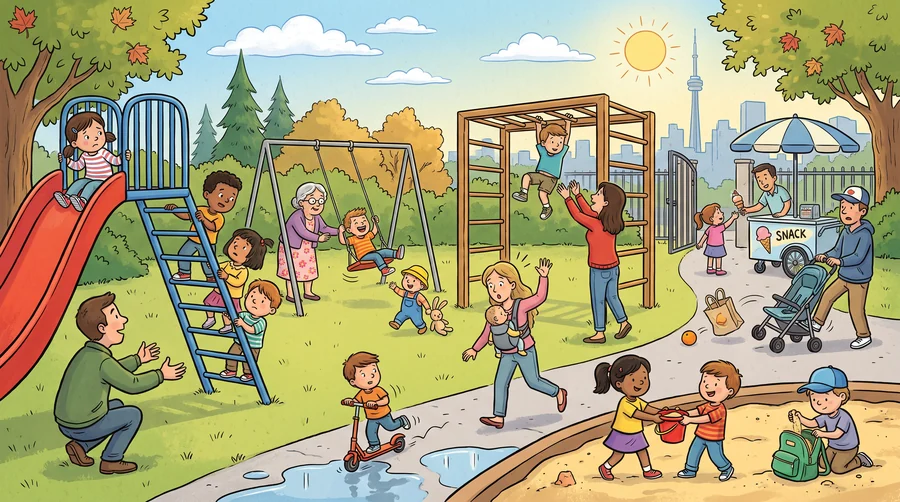
Mild is the operative word, though. The frames are built so that a careful reader and a wild one arrive at different answers. If your prediction is that the boy hanging off the climbing frame falls and breaks his arm, you have stopped reading a picture where his mother is already reaching up for his waist and started writing a screenplay. Everyone can predict a catastrophe. Predicting that the man wrestling with the stroller finds his runaway orange fifteen minutes later, covered in sand, and simply leaves it there is what a rater actually has something to reward.

Practise

5 CELPIP Speaking Task 4 questions with model answers

Five illustrations, each holding more unfinished business than you have 60 seconds to use. Open one, read the frame, record your predictions with no clock running, listen back, then reveal the spoken model answer and the reasoning underneath it. Your recording stays in your browser: it is never uploaded and nothing here is scored.

Task 4Chain
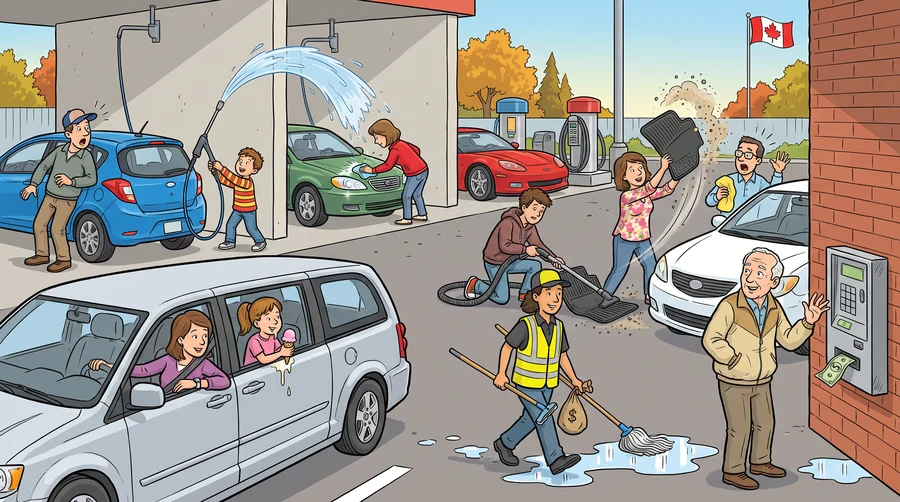
A self-serve car wash with people spraying, vacuuming, shaking mats and waiting in a queue.

A self-serve car wash on a Saturday

A pressure wand arcing over a roof with a child hanging off it, a floor mat being shaken at a freshly washed car, an ice cream cone dangling from a van window. One arc here lands on somebody whose back is turned, and following it there is what makes an answer a chain rather than a list.

Practise this question
Task 4Branching
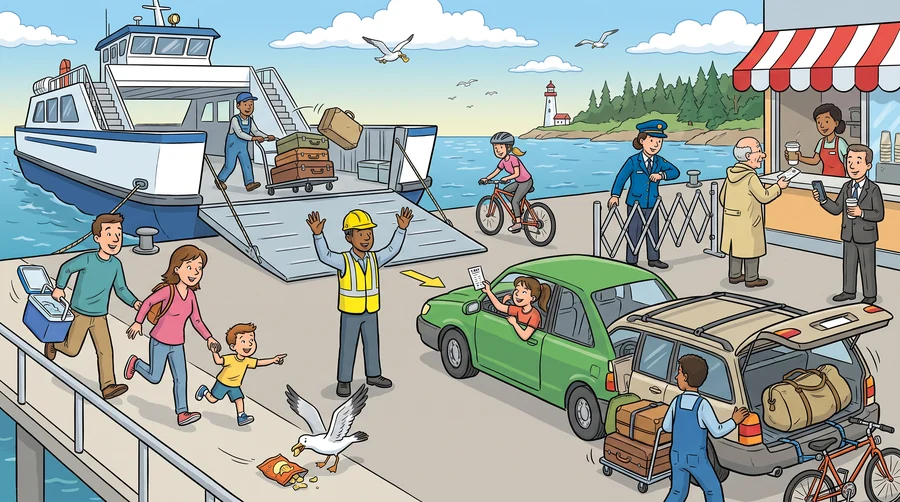
A ferry terminal ramp with cars loading, a marshall waving, foot passengers and a late family running.

A ferry terminal at loading time

A barrier half closed, a family still running for it, and a duffel bag balanced on a bumper that is about to move. The gate is a genuine coin toss, so give both futures and then commit to one with a reason attached.

Practise this question
Task 4Constraints
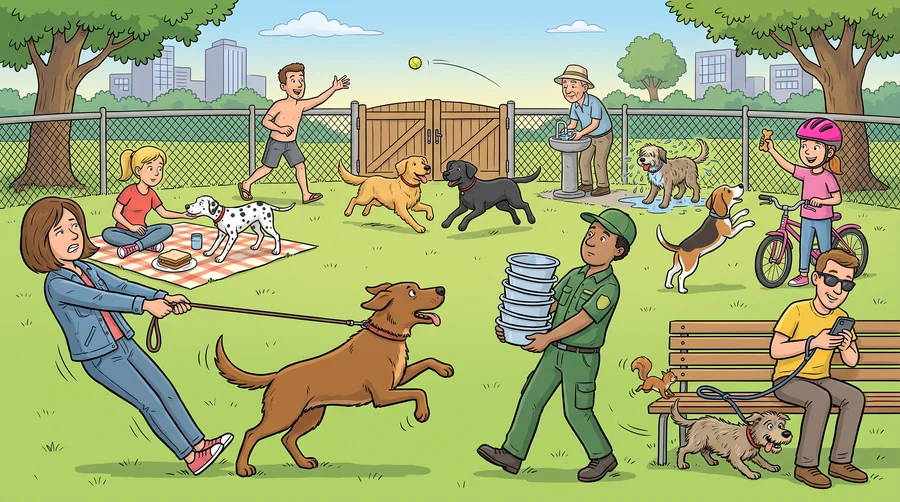
A fenced off-leash dog park with owners, a dog straining at a lead and a ball mid-air.

An off-leash dog park

A large dog up on its back legs at the gate, a sandwich being reached for without looking, a lead looped around a wrist that is not paying attention. Most of these outcomes are settled by physics rather than by anyone's choice, and physics is a stronger reason than a guess.

Practise this question
Task 4Motive
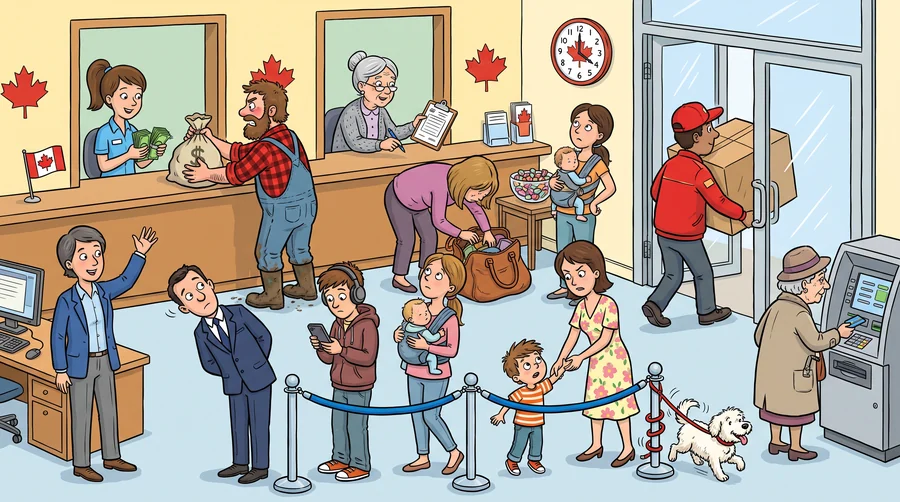
A bank branch with tellers, a long queue, a courier at the door and a child reaching for candy.

A bank branch on a Friday afternoon

A courier reversing through a glass door, a student on his phone who will not feel it coming, a boy being steered away from the candy bowl. The people here all have reasons, and predicting the reason scores higher than predicting the collision.

Practise this question
Task 4Triage
A neighbourhood playground with a slide, swings, a sandbox, a snack cart and a wobbling scooter.

A neighbourhood playground

A toddler wandering into the path of a swing, three impatient children behind a girl at the top of the slide, an orange rolling quietly toward the sandbox. Rank them by how soon they land and forecast the most imminent one first, then attach the motive: she goes down that slide, but not because she wants to.

Practise this question
Tips

Speaking tips for the prediction task

Open on a future verb

"The first thing that is going to happen is ..." Make the very first verb of your answer a prediction and you have structurally locked yourself out of re-describing. It is a one sentence fix for the biggest problem on this task.

Count your arcs in the prep

More is about to happen in that frame than you can fit into 60 seconds. Find the arcs in your 30 seconds and rank them by how soon they land. That ranking is your running order, and it means you never arrive at second forty wondering what else there is.

Hunt for what nobody has noticed

An orange rolling toward a sandbox. A duffel bag on the lip of an open trunk. A vacuum hose that has half swallowed a floor mat. Every planted detail that one person in the frame cannot see is a prediction handed to you for free, and it is the easiest mark on the task.

Say if at least once

"If that cone comes any further out of the window, it is going down their own paintwork." One genuine conditional gives you a complex structure under full control and a consequence that nothing in the frame actually shows. Two is better. Zero is a missed criterion.

Do not save Task 3 material

On test day the two tasks share one picture, and it is not a budget to split. Describe fully in Task 3, then predict fully here. Holding back detail in the description to have something to say later costs you marks twice.

End on a prediction, not a summary

"My guess is he finds it fifteen minutes later, covered in sand, and just leaves it there." A joke is fine. A joke that is still forward looking and still has a timeframe on it is better, and it keeps the last five seconds working.

Questions

CELPIP Speaking Task 4 FAQs

What is CELPIP Speaking Task 4?

CELPIP Speaking Task 4 is Making Predictions. The illustration you have just described in Task 3 comes back on the screen, and you say what will most probably happen next. You get 30 seconds to prepare and 60 seconds to speak. It is the fourth of the eight speaking tasks in the 2026 CELPIP format.

Does CELPIP Speaking Task 4 use the same picture as Task 3?

On the real test, yes. One scene illustration serves both tasks: you describe it in Task 3, then the same image returns immediately in Task 4 and you predict forward from it. Knowing that in advance matters, because anything you spend on prediction during Task 3 is material you will not have here. This practice course is deliberately different. Task 4 has five pictures of its own, so the two tasks give you ten scenes to work on instead of five.

Why do so many candidates lose marks on Task 4?

Because they describe the picture again. It is the single commonest failure on this task and it scores close to nothing, since the rater already has your description from the previous 60 seconds. The marks are in the sentences that leave the frame. If your answer opens with in the picture I can see, it has already gone wrong.

How many predictions should I make in Task 4?

Three or four, from different parts of the frame. A CELPIP scene is built with at least four separate arcs in it, each one a small unfinished story. Predicting one thing in ten seconds and stopping leaves two thirds of the task unused, and covering only the funniest outcome ignores the rest of the picture.

Should every prediction in Task 4 use will?

No, and this is where the easy marks are. Might, is going to, will probably, would most likely, almost certainly and I doubt all carry different degrees of confidence. Grading your predictions by how sure you are is a top band marker under both Vocabulary and Content. Stating everything as a flat certainty flattens the whole answer.

Can I invent things that are not in the picture?

Every prediction has to be traceable to something visible. A fire alarm going off or an ambulance arriving is invention, not prediction, and it reads as an answer that could have been given about any picture. The ice cream cone hanging out of the van window, the orange rolling toward the sandbox and the duffel bag balanced on the open bumper are all planted for you: use them.

Should the predictions be dramatic?

No. A well built scene carries mild momentum rather than catastrophe: somebody getting soaked, a queue backing up, a bag of chips lost to a seagull. If you turn it into a disaster, with a child falling off the climbing frame, you have stopped reading the frame and started writing fiction. Likely, not dramatic, is the standard.

Can I predict what people are thinking or feeling?

Yes, and it is one of the strongest moves available. Predicting a motive rather than only an action, such as she goes down the slide, but not because she wants to, is abstract language sitting on top of a concrete guess. Most candidates predict only objects, and their answers stay flat as a result.

Does this speaking practice course score my answer?

No. There is no timer and no evaluation anywhere in the practice course. You record yourself so that you can hear yourself, the recording stays in your browser and is never uploaded, and then you reveal a spoken model answer with its structure, key phrases and common mistakes.

Is this Task 4 practice updated for the 2026 CELPIP format?

Yes. Everything here follows the 2026 CELPIP speaking format: eight tasks, a timer that runs per task and resets on every advance, and Task 4 running 30 seconds of preparation followed by 60 seconds of recorded speech, using the illustration carried over from Task 3.

Predict it out loud, then hear it back

Five pictures, no clock, no score. Record your predictions, then count how many of your verbs pointed forward. That number is the task.