

40 free samples · Updated for the 2026 CELPIP format

CELPIP speaking samples and sample answers

Forty CELPIP speaking topics across all eight tasks, every one with a full sample answer you can read and listen to. The four picture tasks show a real picture, the way test day does. Record yourself with no timer running, then reveal the model and the machinery behind it: structure, key phrases and the mistakes it avoids. Free, and nothing you record ever leaves your browser.

8 tasks · 40 questions Spoken model answers No timer, no scoring
Practise by section Listening practice is on the way
About these samples

What a CELPIP speaking sample is actually for

Most people preparing for CELPIP Speaking already know what they want to say. What they do not know is what a strong answer sounds like: how fast it goes, where it pauses, how much invented detail is normal, how it opens, and where the marks actually come from. That is the gap a good sample closes, and it is why every sample answer here is spoken as well as written. Reading a transcript teaches you the words. Hearing it teaches you the pace, and pace is a scored criterion on this section.

This page collects 40 CELPIP speaking topics, five for each of the eight tasks in the 2026 format. Each one gives you the exact prompt, a real picture where the test shows one, a full sample answer with audio, and then the reasoning broken into three parts: how the answer is built move by move, the key phrases worth reusing on a question you have never seen, and the common mistakes the answer was written to avoid. The point is never to memorise the sample. It is to see the method clearly enough that you can run the same method on test day.

That distinction matters more in speaking than anywhere else. A memorised answer bent onto the wrong question is audible in about four seconds, and relevance sits at the top of the Task Fulfillment criterion. What transfers is not the sentences. It is the moves: conceding before you argue, hedging instead of overstating, anchoring a description to something fixed, ending a phone call with an actual request. Those work on any prompt. The words work on exactly one.

And here is the fact that should change how you use this page. In the published performance standards, candidates at completely different levels are responding to the same material. The gap between them is not what they noticed or how interesting their lives are. It is the descriptive machinery they had available to render it. You cannot make your past more eventful before test day. You can absolutely arrive with better machinery, and that is what these 40 samples are: 40 demonstrations of the machinery, with the working shown.

Sample answers in full

3 CELPIP speaking sample answers, with the working shown

One 90 second task, one 60 second story task, and one from Task 8, which is the strangest job on the test. Read them here, then open the other 37 CELPIP speaking sample questions and record your own version first.

1
Task 1 · Giving Advice30s prep · 90s speak on the real test
All 5 Task 1 samples →
The question

Your cousin is thinking about adopting a dog from a rescue shelter. She has never had a pet before, and she has asked you what she should think about first. Give her your advice.

Why it works
  • Approves in the first four words, so the listener knows where the speaker stands before any reasoning arrives.
  • Reframes the question in one abstract line, the love is not the problem, the logistics are, then organizes everything under it.
  • Moves from concrete numbers to an abstract claim about shelter behaviour, which is the concrete-plus-abstract pairing the top bands need.
  • Hedges the risky claims instead of overstating them, which is a band 11 to 12 marker.
  • Closes on one extra low cost action rather than a summary, so the 90 seconds end on something useful.
Sample answer 229 words · about 90s spoken

Honestly, I think it is a lovely idea, but before you fill in any forms, I would sit down and be really honest about an ordinary week. A dog is not a weekend hobby, it is a ten to fifteen year commitment, and the part people underestimate is not the love, it is the logistics. So map out a normal Tuesday. Who lets him out at lunchtime while you are at work? If the answer is nobody, you would probably need a dog walker, and that is roughly forty dollars a week here.

Second, think about money. Between food, the first vet visits and the emergency fund you should really have, you are likely looking at a couple of thousand dollars in year one. Third, and this is the one I would push hardest on, please do not pick the saddest face in the room. Rescue dogs usually come with a history, and a dog who seems nervous in a noisy shelter can be completely different in a quiet apartment. So ask the staff the awkward questions. Has he lived with children? Does he settle when he is left alone? They would far rather tell you the truth than watch him come back in a month. And if they offer fostering, take it. It is a low risk way of finding out what you are actually signing up for.
Key phrases
The part people underestimate is not X, it is Y If the answer is nobody, you would probably need to ... And this is the one I would push hardest on ... They would far rather tell you the truth than ...
2
Task 2 · Talking about a Personal Experience30s prep · 60s speak on the real test
All 5 Task 2 samples →
The question

Talk about a time you had to wait a long time for something you really wanted. Tell your listener what happened and why it mattered to you.

Why it works
  • Names the single event in the first sentence, so the 60 seconds are never spent searching for a topic out loud.
  • Separates the surface event from the real difficulty, which is abstract reasoning inside a concrete story.
  • Gives one specific sacrifice, the job in Halifax, instead of saying it was stressful.
  • Lands the resolution on an anticlimax and a physical detail, which is far more vivid than adjectives.
  • Closes with a two sentence reflection built on a contrast, answering the why it mattered half the prompt asks for.
Sample answer 144 words · about 60s spoken

The one that comes to mind is my permanent residence application. I filed it in the spring of 2019, and then, basically, nothing. For nineteen months there was just a portal that said in progress, and I refreshed it far more often than I would like to admit. The hard part was not the waiting itself, it was that I could not plan anything around it. I turned down a job in Halifax because I had no idea whether I would still be in the country. And then one Thursday morning it simply appeared. No phone call, no ceremony, just a line of text on a screen. I sat in my car in the parking lot and cried, which honestly surprised me. It mattered because it taught me something uncomfortable about myself. I am fine with hard things. I am terrible with uncertain ones.

Key phrases
The one that comes to mind is ... The hard part was not X itself, it was that ... And then one Thursday morning it simply appeared It taught me something uncomfortable about myself
8
Task 8 · Describing an Unusual Situation30s prep · 60s speak on the real test
All 5 Task 8 samples →
The question

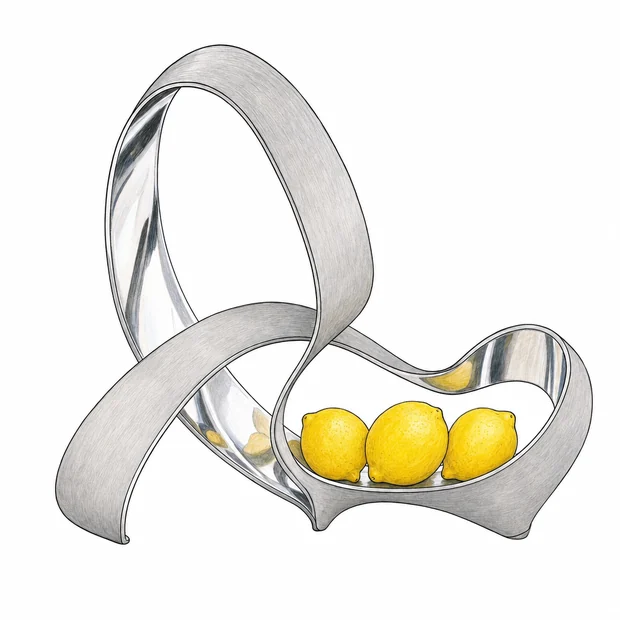
You are at a home decor shop looking for a wedding present for two friends, and you find the object in the picture below. It costs $150. The shop has a no photography sign at the door, because their designs get copied, so your friend Ingrid cannot see it for herself. Call Ingrid, who is paying for half of the present, describe the object to her, and ask her whether you should buy it.

A twisted steel ribbon bent into a crossing loop, cradling three lemons at its low dip.
Why it works
  • Finishes the wrapper in two sentences: where he is, what he has found, and why she cannot simply look.
  • Hands over one familiar shape before bending anything, so she is holding a ribbon of steel before the hard part starts.
  • Follows the ribbon itself in a fixed order: along its length, up to the high side, down into the low one, then onto the three points it stands on.
  • Sizes by comparison rather than in units, which is the core circumlocution move when a thing has no name to fall back on.
  • Stops on the one feature with no label, the two surfaces, and proves it with a consequence instead of an adjective, then puts the price right before the request.
Sample answer 144 words · about 60s spoken

Ingrid, hi. I am at that home shop on Bank Street and I think I have found the wedding present, but they have a no photography sign up, so I cannot show you. Right. Imagine a single ribbon of steel, about as wide as three fingers and roughly the length of your arm. Somebody has bent it into a loop that crosses over itself twice, so it climbs up on one side, almost to my elbow, and dips right down to the table on the other. The low dip is where the fruit goes. It balances on three points, just where the ribbon touches down, and there is nothing else holding it up. The outside is brushed matte, and the inside is polished like a mirror, so a lemon sitting in it appears twice. It is a hundred and fifty. Should we buy it?

Key phrases
They have a no photography sign up, so I cannot show you Imagine a single ribbon of steel, about as wide as three fingers So it climbs up on one side and dips right down on the other Should we buy it?
The other 37 samples work exactly the same way, and each one hides its model behind a button so you record first. Browse all 40 topics →
All 40 questions

Every CELPIP speaking topic, grouped by task

Open any topic to practise it. There is no timer, nothing is scored, and the sample answer stays hidden until you have recorded yourself or asked to see it anyway. Tasks 3, 4, 5 and 8 open with a real picture, because those are the four the test illustrates. Each task number also has its own page explaining what that task rewards.

2026 format

The 8 tasks these samples follow

Every sample answer here is written to the official 2026 CELPIP speaking format, so its length is something you can actually reproduce on test day. The timer runs per task and resets on every advance, and the preparation is never skippable.

Task
What it asks
Prep · Speak
1 · Advice
Somebody has a problem and has asked you what to do. Text only.
30s · 90s
2 · Experience
One event from your own life, plus why it mattered. Text only.
30s · 60s
3 · Scene
Describe an illustration to somebody who cannot see it.
30s · 60s
4 · Predictions
The same illustration returns. What will most probably happen next.
30s · 60s
5 · Persuading
Three screens. Choose between two options, then persuade somebody who wants a third.
60s · 60s
6 · Difficulty
An awkward situation and two people you could speak to. Choose one. Text only.
60s · 60s
7 · Opinions
One question about an everyday issue. Take a position. Text only.
30s · 90s
8 · Unusual
Describe something odd down the phone to a named person, and ask them something.
30s · 60s
Scored on
Content and Coherence, Vocabulary, Listenability and Task Fulfillment, on every one of the eight tasks. All eight together produce one band on the CLB 1 to 12 scale.

Two of those four criteria are worth a second look, because they are where speaking stops resembling writing. Listenability is speaking-only: rhythm, pronunciation and intonation, pauses and self-correction, grammar and sentence structure, and variety of sentence structure. It is not an error count. It is control first, then range, which is why a fluent answer with two small stumbles outscores a careful one delivered in a monotone. And Task Fulfillment covers relevance, completeness, tone and length, which is why the prompt telling you that the listener is your aunt rather than a stranger is information you are being scored on rather than decoration.

How to use them

Getting something out of a sample answer

Record before you reveal

Every question here hides its sample behind a button for a reason. Once you have heard a good answer you cannot unhear it, and your own attempt stops being yours. Record first, badly, then compare. The gap you find is the lesson.

Listen to your own recording

This is the part everyone skips and it is the whole point. You will hear the filler, the flat rhythm, the moment you started repeating yourself. Nobody else needs to hear it: the recording stays on your device and is never uploaded anywhere.

Steal the moves, not the words

The key phrases are written as patterns with an X and a Y in them on purpose. The part people underestimate is not X, it is Y. Those survive contact with a question you have never seen. The sentences around them do not.

Read the mistakes first

Each sample lists the common mistakes it was written to avoid. They are more useful than the answer itself, because they describe what you are probably already doing. Re-describing the picture. Listing feelings. Never asking.

Drill one task at a time

The eight tasks reward genuinely different things, and mixing them teaches you nothing quickly. Do all five questions from one task in a sitting, and by the fifth the shape starts arriving without being summoned.

Then put the clock back on

This course exists to build the method with no pressure. Once it is automatic, the timed speaking tests put all eight tasks back under the real prep and response limits, and return expert feedback and a CLB band.

Practice course vs timed tests

Why nothing here is timed or scored

The two modes on this site do different jobs, and using the wrong one at the wrong stage wastes weeks. The practice course is for the learning phase: one task at a time, no clock, and a model answer waiting behind a button. You can spend twenty minutes on a 60 second answer if that is what it takes to get the shape right, because nothing is being measured.

That is why the recorder here works the way it does. You record for your own ears. The audio is held in your browser, it is never uploaded to us or to anybody else, and it is never scored by anything. The official prep and response times are printed on every question as information, and then deliberately ignored: nothing will cut you off mid-sentence. If your microphone is blocked, the samples all still open, because no lesson on this page depends on a working mic.

The timed speaking tests are the rehearsal phase, and they are where the pressure belongs.

 
Practice course
Timed speaking tests
Timer
None, ever
Real prep and response limits, per task
Scope
One task at a time
All 8 tasks, back to back
Your recording
Stays in your browser. Never uploaded.
Submitted, so it can be assessed
What you get back
A spoken model answer plus the reasoning
Expert feedback and a CLB band
Is it scored
No. Nothing is evaluated in this mode.
Yes, against the official criteria
Best used
While you are still learning the shape of an answer
In the last few weeks before test day
Questions

CELPIP speaking samples FAQs

What is a CELPIP speaking sample?

A CELPIP speaking sample is a full model answer to a real-format speaking question, ideally spoken rather than only written, so you can hear the pace and the pausing as well as read the words. Every sample on this page comes with the reasoning underneath it: how the answer is structured, which phrases carry the weight, and which common mistakes it deliberately avoids.

How many CELPIP speaking samples are on this page?

Forty. Five questions for each of the eight speaking tasks, each with a spoken sample answer, a written transcript, a structure breakdown, key phrases and a list of common mistakes. All of it is free and none of it requires an account.

What are the most common CELPIP speaking topics?

Ordinary Canadian life, always. Advice about a pet or a first job interview, a story about a long wait or a mistake, a busy laundromat or a pharmacy counter, a car wash or a playground, a laptop against a tablet, a hotel with no record of your booking, an opinion about school hours or garbage fees, and an object in a shop that has no obvious name. Nothing on the test requires specialist knowledge or current affairs.

Should I memorise CELPIP speaking sample answers?

No. A memorised answer aimed at a question it was not written for is audible, and relevance sits at the top of the Task Fulfillment criterion. Copy the moves rather than the words: the concession, the hedge, the spatial anchor, the closing request. Those transfer to a question you have never seen. The exact sentences do not.

How long should a CELPIP speaking answer be?

It depends on the task. Tasks 1 and 7 give you 90 seconds, which is roughly 200 to 230 words at a natural pace. Tasks 2, 3, 4, 5, 6 and 8 give you 60 seconds, which is about 130 to 150 words. Every sample answer on this page is written to fit its own task without rushing.

Does this speaking practice course score my answers?

No. There is no timer and no evaluation anywhere in the practice course. You record yourself so you can hear yourself, the recording stays in your browser and is never uploaded, and then you reveal the sample answer. The timed speaking tests are the other mode, and they return expert feedback and a CLB band instead.

Are these CELPIP speaking samples free?

Yes. All 40 questions, all 40 spoken sample answers and every explanation are free, with no account and no credit card required.

Why do some tasks here have no picture?

Because the real test shows none on those tasks. Tasks 1, 2, 6 and 7 are text prompts on test day, so they are text prompts here. The four picture tasks all have real pictures: five scenes for Task 3, five more for Task 4, a photograph of each option on Task 5, and the object itself on Task 8, which is 25 images in total. They are drawn for this course rather than lifted, because Paragon's own illustrations are their copyright.

How is the CELPIP speaking section scored?

Every one of the eight tasks is scored on four criteria: Content and Coherence, Vocabulary, Listenability, and Task Fulfillment. All eight together produce one speaking band on the CLB 1 to 12 scale. Listenability is speaking-only and covers rhythm, pronunciation, pausing, self-correction and sentence structure.

Are these speaking samples updated for the 2026 CELPIP format?

Yes. All 40 follow the 2026 CELPIP speaking format: eight tasks, a timer that runs per task and resets on every advance, 30 or 60 seconds of preparation depending on the task, and 60 or 90 seconds of recorded speech.

Record one, and hear what you actually sound like

Forty samples, no clock, no score, no account. Your recording never leaves your browser. Start with Task 1 and work down, or pick the task you dread.