Speaking Task 3 · Free · 2026 CELPIP format

CELPIP Speaking Task 3: Describing a Scene

Five untimed CELPIP Speaking Task 3 questions, each with its own picture and a spoken model answer. The scene is right there on the screen, exactly as it will be on test day, and your job is to render it out loud for a listener who cannot see it. Record yourself, reveal the model, then read exactly how it is put together.

30s prep · 60s speak No timer in this course Nothing recorded is uploaded
How this task works

What CELPIP Speaking Task 3 actually asks you to do

On the real test, Task 3 puts an illustration on the screen: an ordinary Canadian place at its busiest hour, of the kind you will find in the five below, a laundromat, a bakery, a school pickup zone, a bike shop, a pharmacy counter. Eight or ten people are in it, each doing one legible thing, clustered into little groups. The instruction is to describe the scene to somebody who cannot see it, and the image stays on screen for the whole 60 seconds, so nothing has to be memorised.

Every question below gives you a real picture, because a describing task without one is not the task. The five CELPIP Speaking Task 3 pictures on this page are our own illustrations, drawn to the brief the real scenes are built on: an ordinary Canadian place at its busiest hour, five or six clusters of people, and in every cluster somebody doing something to somebody else. You look, you choose, you talk. That is the whole loop, and it is the loop you cannot rehearse from a paragraph.

Now the thing that reframes this task. It is tempting to think Task 3 rewards observation, that the high scorers are the ones who spot more. The published performance standards say otherwise, and the evidence is uncomfortable: candidates at wildly different levels are described responding to the same picture. They saw the same room. What separated them was the descriptive machinery they had available to render it. Nobody lost marks for missing the dog in the corner. They lost marks for saying "there is a dog in the corner".

Which is why the single clearest marker of a low band on this task is a list of objects. "There is a washer. There is a basket. There is a folding table." Every sentence grammatical, every sentence useless, because a scene is not a stock list. It is people doing things to each other, and the verb is where the marks live.


The gap, concretely

Same detail, two bands

In every pair below, both sides are looking at the identical thing in the identical picture. Nothing was noticed on the right that was missed on the left.

Capped

There is a woman with a sheet at the table.

Lifted

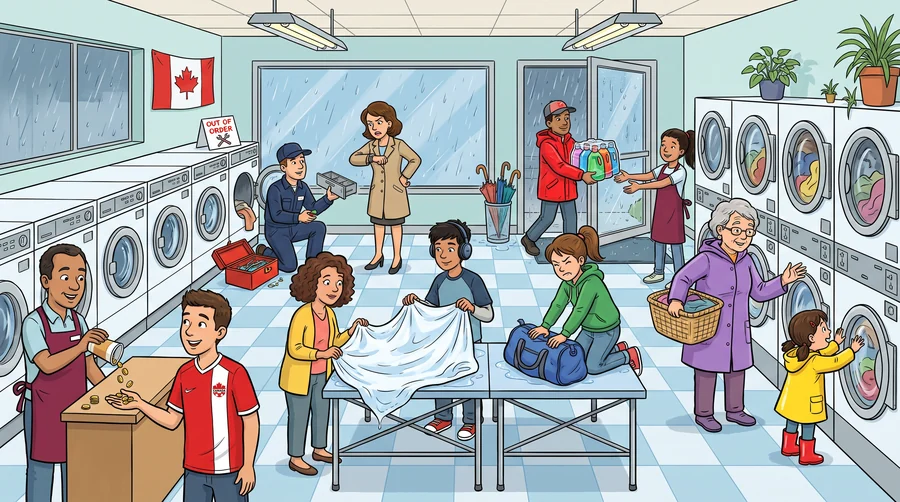
A woman in a yellow cardigan has a wet bedsheet by two corners and is pulling it straight against a teenager in headphones holding the other end.

Capped

A boy is at the counter. He has a ticket.

Lifted

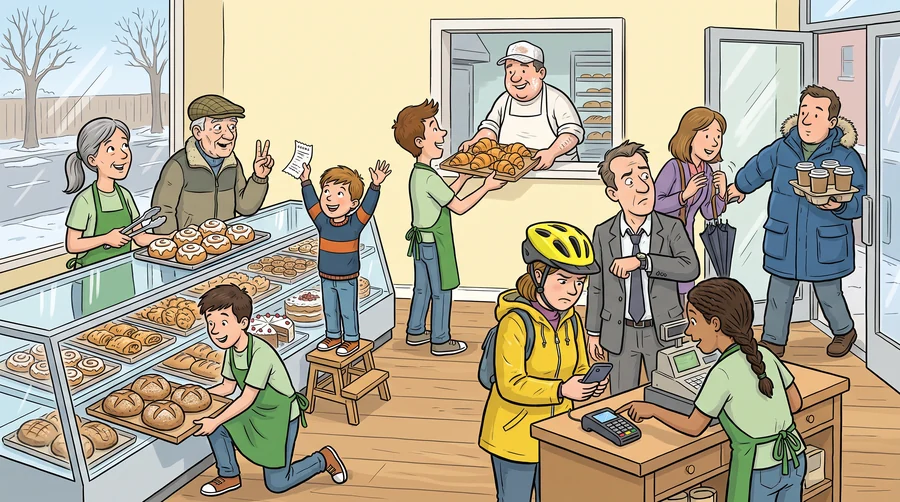
A boy of about seven is up on a step stool, holding his paper ticket out over the counter at a server who has already turned away.

Capped

There is a boy with a bucket next to a man fixing a bike.

Lifted

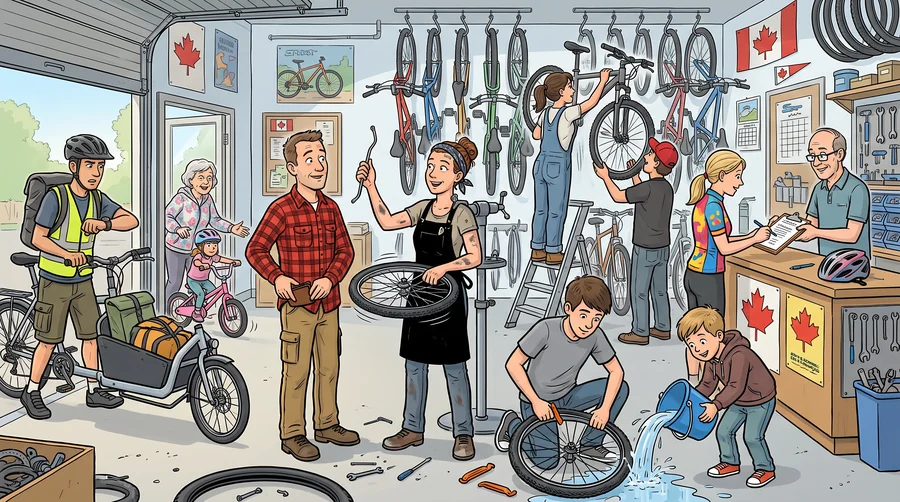
A boy of about ten is crouched beside the apprentice levering the tire off, craning in so far to watch that the water bucket is tipping in his hand, which he has plainly forgotten he is holding.

Capped

There is a man with boxes. There is a girl.

Lifted

A clerk in a green polo shirt is kneeling to stack boxes of tissues into a pyramid, and a small girl is quietly working one loose from the bottom of it, which he cannot see from down there.

Look at what changed. Precise verbs where the left side had is and has. Complete clauses where the left side had noun phrases. A relationship between two people where the left side had two people. And on the last two, one extra move that costs four words and is worth more than anything else on this page: an inference laid on top of the description. Nobody can see that the boy has forgotten he is holding the bucket. That is the speaker reading the room, and it is the concrete-plus-abstract pairing the top bands require.

Official format

CELPIP Speaking Task 3 format at a glance

The 2026 CELPIP speaking format for the scene description task specifically.

Official name
Speaking Task 3: Describing a Scene
Position
Third of the 8 speaking tasks, and the first with an image
Preparation
30 seconds, not skippable, with the illustration on screen
Recording
60 seconds, with the image still visible throughout
What you see
One illustration of a busy ordinary place, roughly 8 to 12 people in 3 to 5 groups. The 5 pictures in this course are drawn to the same brief.
The catch
On the real test, Task 4 hands you this exact image again: one scene, two tasks, two completely different jobs. In this course Task 4 has its own 5 pictures, so you practise on 10 scenes rather than 5 twice.
Roughly
130 to 150 words at a natural pace, which is 4 vignettes developed, not 8 named
Scored on
Content and Coherence, Vocabulary, Listenability, Task Fulfillment
Rater view

What raters actually reward in CELPIP Speaking Task 3

Five moves. They are learnable in an afternoon and they are worth more than a year of vocabulary lists.

One line of overview first
"This is a laundromat on a rainy Saturday, and it is busy but not chaotic." Place plus a judgement about its mood, before any detail. The listener now has a container, and every following sentence goes into it. Starting on a detail leaves them holding an attendant and no room to put her in.
Announce a route and keep it
Left, middle, right, far corner. Or front, behind, middle, back fence. A listener can only assemble a space if the tour has an order, and organization is named explicitly under Content and Coherence. Jumping around the room at random wastes good sentences.
Anchor to the room, not to yourself
"Behind the counter", "along the back wall", "directly underneath a sign". Fixed landmarks travel down a phone line. "Over there" and "this one here" refer to nothing, because your listener is not standing where you are, and forgetting that is a Task Fulfillment problem, not a slip.
Verbs from the setting
Kneeling, balancing, steadying, reaching past, wedging, folding, truing, spinning. Vocabulary is scored on precision and range, and a bike shop answer that uses the bike shop's own verbs demonstrates both at once. Generic movement words are the cheapest thing you can say.
An inference, hedged
"His dad is checking his watch, so I would guess they are late for something." You cannot see lateness. You read it. One or two of these turn a description into an interpretation, and the hedge is what keeps it honest and what marks the top bands.

The hardest discipline here is arithmetic, not language. A CELPIP scene has seven or eight groups in it. Sixty seconds is roughly 140 words. Cover all eight and you have seventeen words each, which is exactly enough for "there is a man with a dog" and not one syllable more. Take four and you have thirty-five words each, which is room for a precise verb, a spatial anchor and an inference. The candidates who feel they must mention everything are being punished by their own thoroughness, and it is the commonest self-inflicted wound on this task.

One more discipline, and it is a matter of restraint. Every good scene is built with near collisions in it: a bucket of water tilting too far, a small girl tugging a box out of the bottom of a stack. You will want to finish those stories. Do not. Prediction is the next task, and on the real test it runs on this very picture, so everything you spend here you will not have in the 60 seconds that follow. Describe the frozen frame and let the tension sit.

Practise

5 CELPIP Speaking Task 3 pictures with model answers

Five Canadian scenes, each with its own illustration to look at while you talk, exactly as the real task works. Choose a picture, describe it aloud with no clock anywhere on the screen, then listen to yourself before you open the spoken model and the reasoning beside it. Your take stays on your own device, and no one scores it.

A busy laundromat with an attendant, a technician at an open washer, and people folding laundry.
Task 36 groups

A laundromat on a rainy Saturday

A cup of coins tipped into a palm, a wet bedsheet pulled straight between two people, a coin slot drawer held up at a woman tapping her wristwatch. Six groups and sixty seconds: the arithmetic settles this one before the language does.

Practise this question
A crowded bakery with a display case, servers with tongs, a queue and a kitchen hatch.
Task 3Queue

A bakery at the morning rush

Tongs held over the cinnamon buns, two fingers held up, a boy on a step stool waving a ticket at a server who has turned away. The marks here sit with the people being ignored, not the people being served.

Practise this question
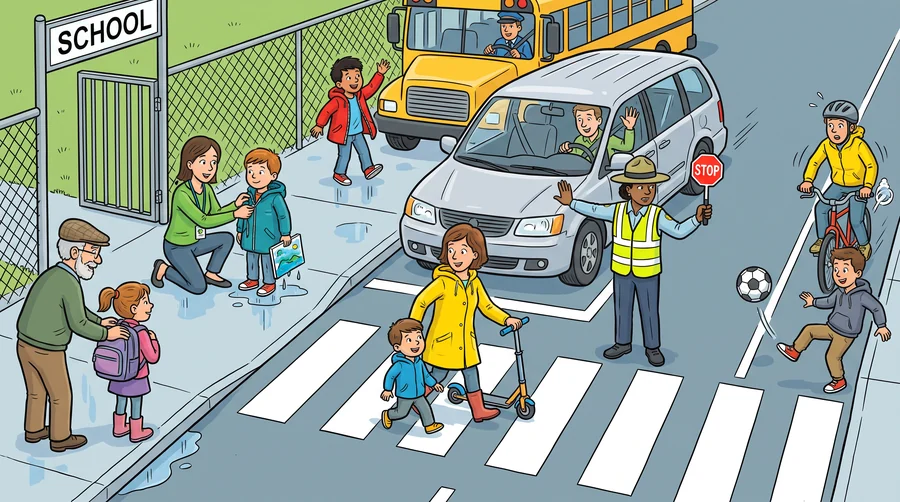
A school pickup zone with a crossing guard stopping a minivan and families at the gate.
Task 3Traffic

A school pickup zone at three o'clock

A stop paddle held out flat at a braking minivan, a dripping wet painting offered to a kneeling teacher, a ball loose in the bike lane. Depth as well as width: this one needs the crosswalk, the gate, the curb and the bus opposite.

Practise this question
A crowded bike repair shop with mechanics at a repair stand and bikes on ceiling hooks.
Task 3Workshop

A bicycle repair shop in spring

A bent spoke held up at a man reaching for his wallet, a bucket of water tilting too far, a girl wobbling away with nobody holding the saddle. The shop lends you its own verbs, and they outscore any adjective you bring.

Practise this question
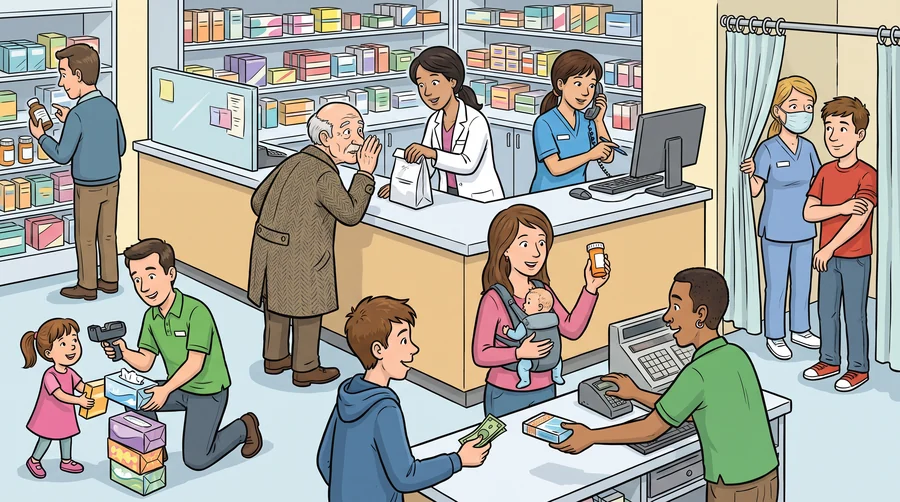
A busy pharmacy counter with a pharmacist, a technician on the phone and a clerk stocking shelves.
Task 3Counter

A drugstore pharmacy counter

Everyone behind the counter is doing two things at once: a stapled paper bag held out over the raised counter, a phone jammed against a shoulder, a pill bottle raised and unnoticed. This one pays for the exact register, right down to the aisle.

Practise this question
Tips

Speaking tips for the scene description task

Use the 30 seconds to choose, not to scan

Pick your four vignettes and your route during the prep. The picture is not going anywhere, and the one thing you cannot recover from is arriving at second forty with three groups left and no plan for which to drop.

Ban two verbs

There is, and there are. Not forever, just as a drill. Forbidding them forces you into the verb the person is actually performing, which is the whole difference between a stock list and a scene. Do it for a week and it becomes automatic.

Find the failed interaction

A kindergartener holding a dripping wet painting out at a teacher who is leaning her face away from it. A woman holding an empty pill bottle up at a technician who is already on the phone. Two people whose actions do not meet is worth more than five people whose actions are fine, and every good scene plants at least one.

Save the funniest for last

A description has nothing to summarize, so "in conclusion, that is the picture" is ten wasted seconds. End on the man asleep with a newspaper over his face. It lands, it is memorable, and it is still description.

Talk around the missing word

If the noun will not come, go around it. The sign on a stick the crossing guard holds out at the cars. A pause while you hunt costs more than the word is worth, and smooth circumlocution is a skill the raters can hear, not a failure they overlook.

Practise on a window

A cafe, a bus stop, a playground. Sixty seconds out loud describing what people are doing to each other, with a route and no there-is. This task is the one you can rehearse anywhere without a book.

Questions

CELPIP Speaking Task 3 FAQs

What is CELPIP Speaking Task 3?

CELPIP Speaking Task 3 is Describing a Scene. An illustration of a busy everyday place appears on the screen, and you describe it to somebody who cannot see it. You get 30 seconds to prepare and 60 seconds to speak. It is the third of the eight speaking tasks in the 2026 CELPIP format.

Are there pictures in this CELPIP Speaking Task 3 practice?

Yes. All five CELPIP Speaking Task 3 pictures are on this page and inside each question: a laundromat, a bakery, a school pickup zone, a bicycle repair shop and a pharmacy counter. They are our own illustrations drawn to the same brief the real test uses, a busy Canadian place with five or six groups of people caught mid action, because a describing task you practise without a picture is not the task.

How long is CELPIP Speaking Task 3?

Thirty seconds of preparation with the image on screen, then 60 seconds of recording. The image stays visible while you speak, so nothing has to be memorised. Sixty seconds is about 130 to 150 words, which is four vignettes described properly rather than eight named quickly.

Do I have to describe everything in the picture?

No, and trying to is the classic way to score badly. A CELPIP scene has seven or eight groups of people in it and 60 seconds allows roughly four of them to be described with a verb worth hearing. Covering all eight forces four words each, which produces a list read aloud. Select and develop.

What separates a high band from a low band in Task 3?

Not what you noticed. The published performance standards show candidates at very different levels describing the same picture: the gap is the descriptive machinery, not the observation. Precise verbs instead of is and has, spatial anchors, an inference laid on top of the description, and complete clauses instead of noun phrases.

Should I predict what happens next in Task 3?

No. Prediction is Task 4, and on the real test it hands you this very illustration again and asks exactly that. Sliding into what will happen next during Task 3 leaves your description thin and spends material you will want in the 60 seconds that follow. Describe the frozen frame and let the near collisions sit there unresolved.

Does Task 4 use the same picture as Task 3?

On the real test, yes: one scene illustration serves both tasks, so you describe it in Task 3 and then the same image returns in Task 4 for you to predict what will most probably happen next. That is why the scenes are built with people caught mid transaction rather than sitting still. In this practice course Task 4 has its own five pictures instead, so that you get ten scenes of practice rather than five seen twice.

What if I do not know the word for something in the picture?

Go around it. A hesitation while you hunt for a noun costs more than the noun is worth, and Listenability scores pauses. Say the raised part of the counter, the thing he is pricing the boxes with, the drawer the coins come out of. Working around a missing word smoothly is a skill the top bands actively display.

Does this speaking practice course score my answer?

No. There is no timer and no evaluation anywhere in the practice course. You record yourself so that you can hear yourself, the recording stays in your browser and is never uploaded, and then you reveal a spoken model answer with its structure, key phrases and common mistakes.

Is this Task 3 practice updated for the 2026 CELPIP format?

Yes. Everything here follows the 2026 CELPIP speaking format: eight tasks, a timer that runs per task and resets on every advance, and Task 3 running 30 seconds of preparation followed by 60 seconds of recorded speech, with its illustration carried forward into Task 4.

Describe it out loud, then hear it back

Five pictures, no clock, no score. Record your description, listen for how many times you said there is, then compare it with a model that never does.